
計畫主持人:趙吉光教授
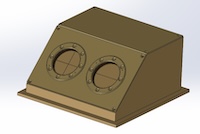
Central University and National Cheng Kung University, is proposed for installation on the second FORMOSAT-9 satellite (FS-9B) operated by the Taiwan Space Agency. Building on FORMOSAT-7 (FS-7), whose data users span 92 countries, the mission aims to extend Taiwan’s international scientific contribution and establish a domestically controlled multi-satellite space-weather observation network combining GNSS radio occultation and reflectometry with in situ plasma measurements. SWIP is developed, manufactured, and integrated in Taiwan, allowing independent control of measurement modes, operating parameters, and data products while retaining key technical knowledge in instrument design, calibration, operation, and data analysis. It consists of the Compact Ionospheric Probe (CIP) and the Electron Temperature and Density Probe (TeNeP), which together measure ion composition, density, velocity, and temperature, as well as electron density and temperature. FS-9B will observe the topside ionosphere near 514 km before midnight; combined with FS-9A observations at the same altitude but a slightly later local time, the measurements can be used to study changes in equatorial plasma bubbles and associated irregularities toward midnight. FS-8A observations at a similar local time but a higher altitude will further support analysis of vertical structure and altitude dependence. Coordinated operation of SWIP and the GNSS RO-R payload on FS-9B will enable comparisons between the local plasma environment and changes in GNSS signal amplitude, phase, tracking stability, and data quality, supporting evaluation of ionospheric effects on GNSS reception, occultation retrievals, reflectometry, communication, navigation, and timing. Because SWIP does not depend on GNSS signals, it can also provide an independent reference for distinguishing ionospheric disturbances from radio-frequency interference or other signal anomalies. Together with observations from FS-5/CIP, FS-7/IVM, INSPIRESat/CIP, PEARL/CIP, FS-8A/TeNeP, and FS-9A/SWIP, SWIP will strengthen Taiwan’s independent capability in ionospheric monitoring, modeling, forecasting, and Space Situational Awareness.
本團隊由國立中央大學與國立成功大學共同為「福衛九號第二顆衛星(FS-9B)科學酬載開發與應用」提出太空天氣探測儀(Space Weather Ionosphere Probe, SWIP)研製計畫。FS-7以GNSS掩星結合離子速度儀,建立電離層遙測與現地電漿協同觀測能力,資料使用者遍布92個國家,展現我國太空任務的國際連結與科學影響力。太空科技亦是我國具有基礎與自主研發能力,在國際具有優勢的科技領域。若FS-9A與FS-9B均搭載SWIP,可延續FS-7星系觀測架構,在我國自製衛星平台上建立結合GNSS掩星與現地量測的多衛星太空天氣觀測網路,並補充高緯度電漿觀測資訊。SWIP由我國團隊自主研發、製造與整合,可依任務需求調整量測模式、操作參數與資料產品,並掌握儀器設計、校正、操作及資料分析等關鍵技術,降低對國外酬載與技術支援的依賴。SWIP由小型電離層探測儀(Compact Ionospheric Probe, CIP)與電子溫度密度儀(Electron Temperature and Density Probe, TeNeP)組成,可同步量測離子成分、密度、速度與溫度,和電子密度與溫度,主要用於研究太空天氣事件對上層電離層之影響,並提供模式驗證、資料同化與預報所需之觀測資料。CIP延續FS-5先進電離層探測儀(Advanced Ionospheric Probe, AIP)之離子量測能力,並具備較小體積、質量與功耗;TeNeP則提供小型化之電子密度與溫度量測。SWIP可於514公里高度觀測午夜前之上層電離層及赤道電漿泡;結合FS-9A觀測,可比較其由午夜前至午夜附近的變化;另與FS-8A配合,則可分析電離層之垂直分布結構。FS-9B GNSS掩星酬載若與SWIP共同運作,可在同一衛星平台上結合遙測與現地量測,將衛星所在位置之電漿環境與GNSS訊號品質變化做比較,評估電離層擾動對GNSS掩星反演、反射觀測,以及衛星通訊、導航與授時訊號之影響。SWIP資料亦可與FS-5/AIP、FS-7/IVM、INSPIRESat/CIP、PEARL/CIP、FS-8A、FS-9A相關酬載進行多衛星整合,補充國際低軌衛星現地電漿觀測逐漸減少所形成的資料缺口,提升我國在電離層監測與太空形勢感知的自主能力,使我國由國際太空科學資料的使用者與合作者,成為提供重要觀測資料與關鍵技術的國家。